

How to Design a Digital Dosing Pump System for Variable Flow Conditions
A chemical dosing system designed for a constant flow rate may struggle when process demand changes throughout the day. In water treatment, chemical processing, and other industrial applications, variations in flow can lead to inconsistent chemical concentrations, unnecessary consumption, or insufficient treatment if the dosing rate remains fixed.
A well-designed digital dosing pump system addresses this challenge by adjusting chemical delivery according to actual process conditions. However, reliable performance depends on more than the pump itself. Flow measurement, control logic, pump capacity, chemical properties, and system protection must work together.
This guide explains how to design a digital dosing pump system for variable flow conditions while maintaining dosing accuracy, operational stability, and efficient chemical use.
1. Understand the Process Flow Range Before Selecting a Pump
The first step is to identify how much the process flow changes during normal operation. Designing around the average flow alone can result in poor performance when the system operates near its minimum or maximum capacity.
For example, a wastewater treatment line may experience lower flow overnight and higher flow during peak operating hours. If the chemical feed rate stays constant, the chemical concentration in the treated stream can fluctuate.
Before selecting a pump, establish the minimum, normal, and maximum process flow rates. Also determine the required chemical dosage, operating pressure, chemical concentration, and expected operating schedule.
These values help define the pump's required adjustment range. The selected digital dosing pump should be capable of delivering the necessary minimum dose without losing stability while still providing enough capacity for peak demand.
2. Choose the Right Dosing Control Strategy
The control strategy determines how the pump responds when process conditions change. For variable-flow applications, three approaches are commonly considered.
Fixed-Rate Dosing
The pump delivers a preset flow rate regardless of the process flow. This approach may work when process demand is stable, but it is generally unsuitable when the required chemical dose must remain proportional to a changing flow rate.
Flow-Proportional Dosing
In a flow-proportional dosing system, the chemical feed rate changes according to a signal from a process flow meter. As process flow increases, the pump increases its output; when process flow decreases, the pump reduces its output.
This approach is useful when the target chemical dosage per unit of process fluid remains relatively constant.
Feedback-Based Dosing
Feedback control uses measurements such as pH, oxidation-reduction potential (ORP), residual chlorine, or turbidity to adjust chemical delivery.
When both flow and process quality vary, combining flow-proportional dosing with feedback correction may provide better control than relying on either method alone. The flow signal establishes a baseline dose, while the feedback signal adjusts it according to the measured treatment result.
The appropriate strategy depends on process dynamics, sensor reliability, and the time required for the chemical to mix and react.
3. Integrate Flow Measurement with the Digital Dosing Pump
A digital dosing pump can only respond appropriately to a flow signal if the measurement is reliable and correctly configured.
The flow meter should be suitable for the process fluid and the expected measurement range. Its output must also be compatible with the pump controller or the programmable logic controller (PLC) managing the dosing system.
Depending on the equipment, integration may use pulse signals, analog signals such as 4–20 mA, or supported digital communication interfaces.
The controller then converts the measured process flow into a required chemical feed rate. For example, if the target dosage is expressed in milliliters of chemical per cubic meter of process fluid, the controller can calculate the corresponding feed rate from the measured flow.
A key consideration is signal scaling. If the flow meter's output range does not match the configured input range, the pump may respond incorrectly even when both devices are functioning normally.
The system should also define what happens if the flow signal disappears, becomes invalid, or falls outside its expected range. Depending on the process risk, the controller may need to stop dosing, activate an alarm, or enter a predefined safe operating mode.
4. Size the Pump for Both Minimum and Maximum Demand
Correct sizing is essential for a digital dosing pump system operating under variable flow conditions.
An oversized pump may struggle to maintain stable dosing at very low flow rates. An undersized pump may fail to supply enough chemical during peak demand. The design must therefore consider the entire operating range rather than only the maximum required capacity.
A simplified calculation for flow-proportional dosing is:
Required chemical feed rate = Process flow rate × Target dosage
The units must be consistent. For example, if process flow is measured in cubic meters per hour and the target dosage in liters of chemical per cubic meter, the calculated chemical feed rate will be in liters per hour.
The calculation may need additional adjustments when the target is expressed as active chemical mass rather than solution volume. In that case, the concentration and density of the prepared chemical solution must also be considered.
After calculating the required feed rate, compare the minimum and maximum values with the pump's usable operating range at the actual discharge pressure. Do not rely on the maximum rated flow alone.
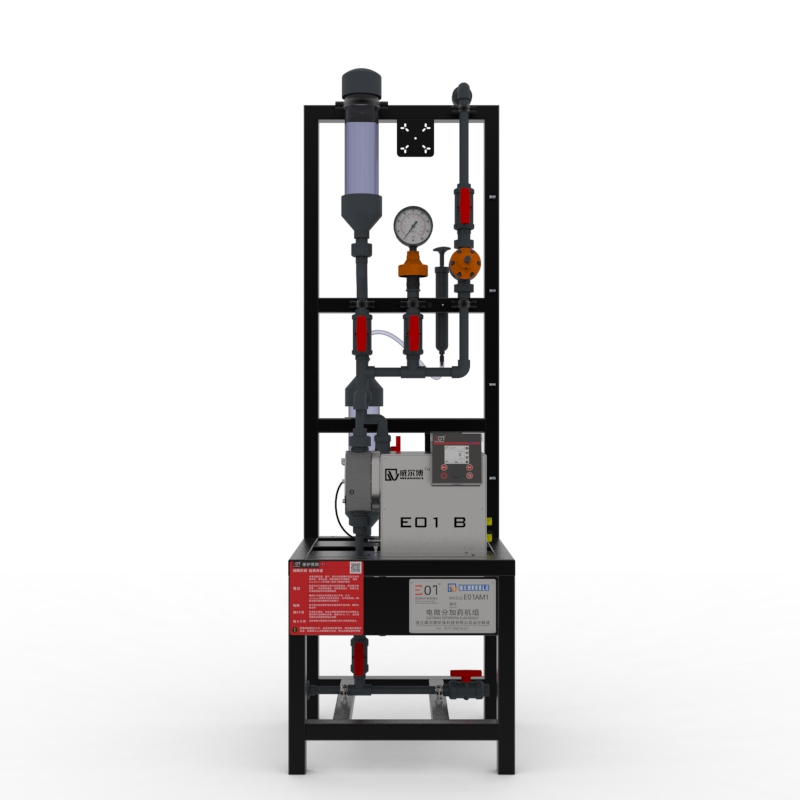
5. Design the Hydraulic System for Stable Operation
Even a well-controlled digital dosing pump can perform poorly if the surrounding piping system creates unstable operating conditions.
Suction piping should allow the pump to receive a consistent chemical supply. Excessive suction lift, air entering the line, clogged strainers, or unsuitable pipe dimensions can interfere with accurate dosing.
The discharge side also needs careful attention. Back pressure, check valves, injection fittings, and changes in downstream pressure can affect actual pump output.
Where appropriate, the system may require a back-pressure valve, pressure-relief protection, or a pulsation dampener. These components serve different purposes and should be selected according to the pump design and process requirements. Pressure-relief protection is particularly important where a blocked discharge line could expose the pump or piping to excessive pressure.
Chemical compatibility must also be verified for the pump head, diaphragm, valves, seals, and all other wetted components. Material selection should reflect the actual chemical concentration and operating temperature.
6. Use Monitoring and Automation to Maintain Dosing Stability
Monitoring helps operators identify problems before they cause significant dosing deviations.
A digital dosing pump system may monitor process pressure, pump status, air bubbles, diaphragm condition, or potential pipeline blockages, depending on its instrumentation. When integrated with suitable control equipment, these signals can support alarms, interlocks, and corrective actions.
For more advanced applications, a PLC can coordinate the pump with flow meters and process analyzers. A supervisory control and data acquisition (SCADA) system can provide centralized monitoring, operating trends, and alarm records.
For example, Wearable's digital dosing pump system supports flow-proportional metering, automated start/stop functions, multiple control modes, and integration with PLC or SCADA platforms, depending on the selected configuration. These capabilities can help adapt chemical delivery to changing process requirements. Actual performance depends on the pump model, system design, and control configuration.
Automation does not eliminate the need for calibration. Sensors must be maintained, input signals verified, and actual chemical output checked under representative operating conditions.
7. Test the System Across the Full Flow Range
Commissioning should verify performance at minimum, normal, and maximum operating flow rather than testing only at one convenient setpoint.
During testing, compare the required chemical feed rate with the measured output. Check whether the pump responds correctly when the process flow increases or decreases, and confirm that alarms and interlocks behave as intended.
Important commissioning checks include:
-
▶ Verify flow-meter calibration and signal scaling.
-
▶ Measure actual chemical delivery at representative operating pressures.
-
▶ Confirm stable operation at low flow and adequate capacity at peak flow.
-
▶ Test signal-loss responses, alarms, and relevant safety interlocks.
Where feedback control is used, allow sufficient time for mixing, chemical reaction, and sensor response. An analyzer located too close to the injection point may provide misleading readings, while excessive process delay can cause the controller to overcorrect and produce oscillating results.
Record the tested operating range and calibration results so future maintenance checks can identify changes in performance.
Common Design Mistakes to Avoid
Several design decisions can undermine an otherwise suitable digital dosing pump system.
| Design Mistake | Potential Consequence | Recommended Approach |
| Sizing only for maximum flow | Unstable dosing at low demand | Check the complete operating range |
| Using fixed-rate dosing for highly variable flow | Overdosing or underdosing | Consider flow-proportional control |
| Ignoring back pressure | Actual output may differ from expectations | Verify performance at operating pressure |
| Relying on unverified sensor signals | Incorrect automatic adjustments | Calibrate and validate instruments |
| Ignoring chemical compatibility | Premature component damage or leakage | Confirm wetted-material compatibility |
| Failing to define signal-loss behavior | Uncontrolled or interrupted dosing | Establish appropriate alarms and safe responses |
The best design is not necessarily the one with the most sensors or the most complicated control logic. It is the one that matches the process requirements and responds predictably to the changes that actually occur.
Frequently Asked Questions
Can a digital dosing pump automatically adjust to changing flow rates?
Yes, if the selected model supports the appropriate external input or automatic flow-control function and is configured correctly. Depending on the system, the pump may respond to pulse signals, analog flow signals, or a controller's output.
Is a flow meter always necessary for variable-flow dosing?
Not in every application. A flow meter is generally useful when the chemical dose must track the measured process flow. Other applications may use batch, time-based, or analyzer-based control, depending on the process objective. The control method should match how the required chemical dose is determined.
Why is dosing accuracy sometimes poor even with digital control?
Digital control cannot compensate for every hydraulic or measurement problem. Incorrect calibration, air in the suction line, unstable back pressure, unsuitable pump sizing, sensor errors, and changing chemical properties can all affect actual delivery.
Should feedback control always be added to flow-proportional dosing?
No. Flow-proportional control may be sufficient when the target dose per unit of process fluid is stable. Feedback is useful when process quality or chemical demand changes independently of flow, provided that the measurement is reliable and the control loop accounts for mixing and reaction delays.
Designing for Consistent Chemical Dosing
Designing a digital dosing pump system for variable flow conditions requires coordinated decisions about pump capacity, control strategy, instrumentation, hydraulic conditions, and chemical compatibility.
Flow-proportional dosing provides a practical way to match chemical delivery to changing process demand. When process quality also varies, feedback correction can improve control, provided that sensors are correctly installed and the control loop is properly configured.
By sizing the pump for the full operating range, verifying actual output, and defining safe responses to abnormal conditions, a dosing system can maintain more consistent performance while helping reduce unnecessary chemical consumption.
For applications that require flexible control under changing process conditions, Wearable's digital dosing pump solutions offer configurable dosing modes, monitoring functions, and automation interfaces to support application-specific system design.
The key is to design around the real process—not just the pump's rated capacity.
